The staging for 'A Slight Ache' was immediately different and I loved the concept completely. With completely bare wings (I could even see the staircase up to the fly floor) with enormous fresnels glowing in the background framed the equally bare set of the sound studio very effectively. Jamie Lloyd is being very frank in his interpretation of this 1958 radio play in setting it where it was intended: a blank sound studio, the only hint of colour in the large 'ON AIR' sign glowing. At first I was skeptical how Gemma Whelan (Flora) and John Heffernan (Edward) were going to manage to create a picture of a fully formed landscape of a countryside home with simply some stools taken from the chemisty classroom and a couple of wired microphones. Oh, how I was wrong. Whilst watching, I completely forgot that the people I was watching were meant to be actors themselves, reading from a script. Gemma Whelan's accent was impeccable - it was clear she had studied the exact anunciations involved in 1950s R.P.
The story began with a cup of tea in the garden and the anxious task of trapping a wasp in a jar of marmalade. Whilst it started off seeming trivial, as soon as the illusive matchseller entered the picture, I knew this would not be the case for long. In true Harold Pinter style, the idyllic setting of the countryside cottage soon became absurd and dark. John Heffernan played the perfect personification of paranoia - growing until the moment they invite the matchseller inside to interrogate him. This part I must admit was very confusing but I feel it was deliberately meant to be this way. Either way, I found myself hooked on every line of the one-sided conversation.
For a staging of a radio play, they used the space of the stage very well. The front of the stage was staggered into steps, which they both used well in this performance. I also thought it was very clever how seamless the integration of handheld microphones and wireless microphones was used - I could not personally tell when each was being used. The stage also had its own sound effects table, making Whelan into a foley artist. Crunching shoes, pouring water and birdsong were all manufactured. However, I did notice this was not always consistent and not all the sound effects were made live (such as the sound of the angry wasp I mentioned earlier).
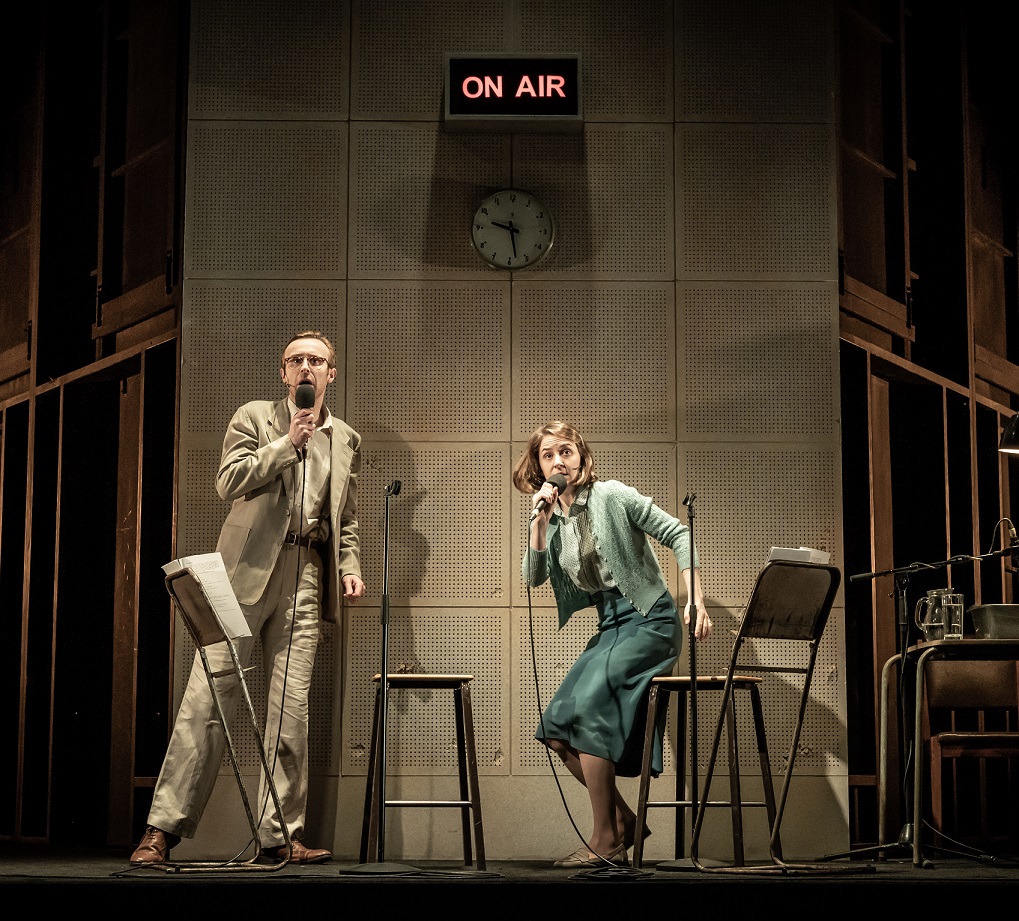 |
| A Slight Ache. Photo: Marc Brenner |
By the end of the performance, I could not tell how deeply these characters were into their respective characters and how much they were actually acting (adding to the absurdist nature of the piece). At one point, whilst Edward is becoming frantic and emotional, the 'ON AIR' sign switches off, but he continues. Is this still part of the script? I must admit though, I enjoy having mysteries and unexplained elements in performances and 'A Slight Ache' certainly delivered.
After an impressive first act, I was eagerly awaiting the second: 'The Dumb Waiter', with Martin Freeman (Gus) and Danny Dyer (Ben). The set of the first act is revolved into the interior of a furnished (but still bare) room. The audience is instantly unsure of where these two men are meant to be and what exactly they are waiting for. The clues are at first not very helpful: they are in Birmingham, they mention driving, the docks and also the mysterious boss who picks their jobs for them. I found it very ironic how these men found the newspaper story of a child killing their cat disgusting yet we soon find out these men kill people for a living. The talk at first seems mundane and the humour comes through - Freeman and Dyer work incredibly well in terms of comic timing and I could tell they really understood their characters. I could tell that Freeman's character Gus was meant to be the more comical role in this performance but he certainly did not dumb down the part - Gus appears to have an understanding of when things are not quite right and definitely has a degree of seriousness to him. After all, he is a hitman.
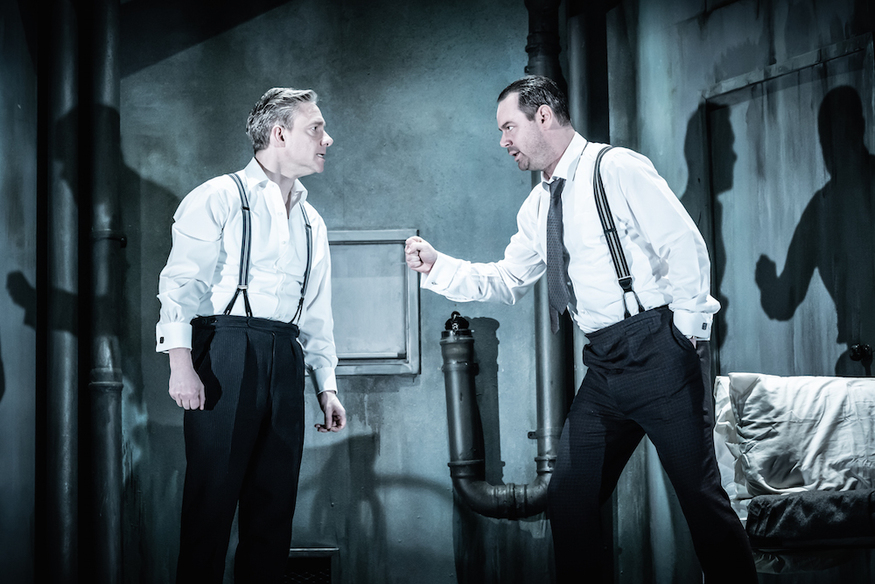 |
| The Dumb Waiter. Photo: Marc Brenner |
Again, in true Harold Pinter style, things start to get absurd quite quickly. A dumb waiter (a double meaning in this performance, I feel) suddenly comes to life and messages begin to be sent. Orders for food and drink are hilariously read out by Gus, a cockney with no idea about foreign or upmarket food. Whilst funny, at this point the audience is still trying to work out (or I was at least) where exactly they were. Where are they? If the kitchen receiving orders is no longer in operation, why are they sending orders down? If this is an operational restaurant, why is there no gas? Not to mention the myterious gift of an envelope of matches slid under the door without explanation.
All of these elements are building up in a storyline in which the audience should know the ending - they are to kill somebody that night. Without spoiling the ending, I personally found the ending quite predictable but it was still done very well and I enjoyed myself thoroughly. Dyer and Freeman would not have been a duo I would have naturally chosen together but they worked incredibly naturally and complemented eachother's strengths well. As with the previous act, there were many unanswered questions at the end (that I attempted to search online to no avail) but I have decided that some things are more interesting left that way: unanswered, and interesting.

No comments:
Post a Comment